Large-scale nature restoration in China: an overview of the main programs
China's reforestation efforts
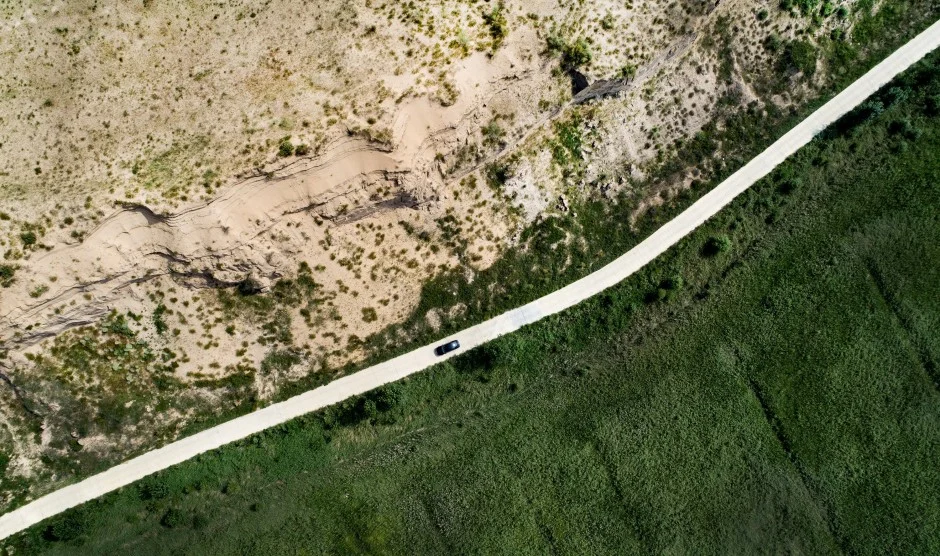
China is typically associated with rapid industrialization and urbanization. Less well known is that since the late 1970s, the country has been working on a series of large-scale ecological restoration programs. This article provides an overview of the main initiatives, the results achieved, and a comparison with the European approach.
The Great Green Wall: a forest belt against desertification
The best-known Chinese restoration program is the Three-North Shelterbelt Programme,internationally better known as the Great Green Wall. The project was launched in 1978 in response to advancing desertification in northern China, caused by the encroaching Gobi and Taklamakan deserts.¹
The program covers thirteen provinces and spans more than four million square kilometers. The ultimate goal is a continuous forest belt of about 5,000 kilometers in length, in some places up to 1,500 kilometers wide.² To date, more than 66 billion trees have been planted. Forest cover in the project area increased from around 5% in 1978 to nearly 14% in 2023.³ In 2024, the Chinese government announced the completion of a 3,046-kilometer green belt around the Taklamakan Desert; recent research shows that this area now functions as a significant carbonsink.⁴
The program will continue until 2050, with the final target of achieving 15% forest cover in the country’s arid north.
The Grain for Green Program: converting farmland back to nature
Severe flooding and increasing soil erosion—particularly on the Loess Plateau—led to the introduction of the Grain for Green Programme in 1999. The core of this program is simple: farmers receive financial compensation to convert steep or erosion-prone farmland into forest or grassland.
In terms of scale, investment volume, and public participation, it is considered the largest ecological restoration program in the world.⁵ Millions of farming households have participated. In addition to ecological effects—less erosion and improved water management—the program has contributed to income stability for participating households.
Protection of natural forests
The catastrophic floods of 1998, partly the result of decades of deforestation, prompted the Natural Forest Conservation Program. This program banned commercial logging in natural forests and provided for large-scale forest management and restoration.
It is considered one of the largest forest protection initiatives worldwide.⁶ Demonstrable results include increased biodiversity, reduced flood risk, and improved water retention. Estimates suggest that the return on investment for this program is significantly higher than that of comparable initiatives.⁷
Wetlands and mangrove forests
Over the past two decades, China has established 903 national wetland parks, protecting a combined 2.4 million hectares.⁸ Notably, China is among the few countries to have achieved a net increase in mangrove forests: since the early 2000s, total mangrove area has grown by around 8,300 hectares to 30,300 hectares.⁹
In 2024, China opened the International Mangrove Center in Shenzhen, a knowledge hub focused on international cooperation in mangrove conservation.¹⁰
Sponge cities: ecological water management in urban areas
A relatively recent and innovative initiative is the Sponge City program, introduced in 2014. Instead of channeling rainwater away through concrete infrastructure, this concept aims to enhance water absorption within the city itself—through wetlands, permeable pavements, rain gardens, and green spaces.¹¹
Shanghai aims to have 80% of the city designed according to this principle by 2030.¹² Dozens of cities, including Wuhan and Shenzhen, are participating. Intended effects include reduced flood risk, improved air quality, and enhanced urban biodiversity.
Comparison with Europe: a significant time gap
China’s programs are impressive in scale, but they also require nuance. Researchers point to large-scale planting of species not well adapted to local conditions, ecologically fragile monocultures, and limited possibilities for independent verification of reported figures.³ Sustainable success requires local adaptation and long-term adaptive management.
When comparing timelines, the gap with Europe is striking:
1978
China launches the Three-North Shelterbelt Programme, while Europe has no comparable large-scale restoration policy.
1989
China starts the Yangtze forest belt programme, while Europe has not yet initiated large-scale restoration efforts.
1998
China introduces the Natural Forest Conservation Program, while Europe has not yet initiated large-scale restoration efforts.
1999
China launches the Grain for Green Programme, while Europe continues without a comparable restoration programme.
2014
China introduces the Sponge City programme, while Europe still lacks a binding framework for ecosystem restoration.
2024
China completes the Taklamakan green belt, while the European Union adopts its first binding Nature Restoration Law.
2026
China’s programmes have been active for 48 years, while EU member states begin implementing national restoration plans.
At the moment the European Union adopted its first legally binding restoration law in August 2024—the Nature Restoration Law (Regulation 2024/1991)— Chinese programs had already been running for 46 years.¹³ The law aims to restore at least 20% ofthe EU’s land and sea areas by 2030, and all degraded ecosystems by 2050.¹⁴
It is important to distinguish between protection and active restoration. Europe has long had relevant legislation: the Birds Directive (1979) and the Habitats Directive(1992) protect existing nature. However, large-scale active restoration of degraded ecosystems is a different challenge, and in this area China is estimated to be about 45 years ahead of Europe. The urgency in Europe is evident from the fact that currently 81% of natural habitats are in poor condition.¹⁵
The structural difference in approach is also relevant. China operates under a centralized governance system and can implement large-scale programs relatively quickly. The European Union must reach consensus among 27 member states, which slows decision-making but also ensures independent oversight, legal enforceability,and democratic legitimacy. Scientists in the journal Nature suggest that China’s experiences—both successes and failures—can offer valuable lessons for restoration efforts elsewhere in the world.³
A meaningful exchange of knowledge and approaches between the two regions therefore appears to be in the mutual interest of both.
Sources:
1. LiveScience — China's Great Green Wall: The giant artificial forest designed toslow the expansion of 2 deserts (december 2025). livescience.com
2. Earth.org — Explainer: What Isthe 'Great Green Wall' of China?earth.org
3. Nature — WhatChina's Great Green Wall can teach the world (april 2026). nature.com
4. UCRiverside, College of Natural & Agricultural Sciences — China's3,046-kilometer "Great Green Wall" has transformed its largest desertinto a carbon sink (februari 2026). cnas.ucr.edu
5. SpringerNature — China: Ecological Restoration Projects for Connected Landscapes(Lu et al., 2018, geciteerd in hoofdstuk 27). link.springer.com
6. NCBI/PubMedCentral — Changes in ecosystem services and an analysis of driving factorsfor China's Natural Forest Conservation Program. ncbi.nlm.nih.gov
7. PMC — Ecologicalrestoration for sustainable development in China (Cao et al., aangehaaldin). pmc.ncbi.nlm.nih.gov
8. CGTN — China'swetland area stays above 56.35 million hectares amid restoration efforts(februari 2025). news.cgtn.com
9. CGTN — China'swetland area stays above 56.35 million hectares (februari 2025). Zie noot8.
10. Xinhua/Scio.gov.cn— China champions global cooperation on wetland conservation at COP15(augustus 2025). english.scio.gov.cn
11. PLOSClimate — Strengthening wetland restoration to increase urban resilience inChina (februari 2026). journals.plos.org
12. PLOSClimate — Zie noot 11.
13. Invest4Nature— EU Nature Restoration Law and the role of Nature-based Solutions(oktober 2024). invest4nature.eu
14. Net ZeroCompare — EU Nature Restoration Law (2024). netzerocompare.com
15. Invest4Nature— Zie noot 13.