We are live! VSME becomes the Voluntary Standard (VS)
🎉 It's here: the Voluntary Standard (VS) is live in Eevery! Our whole team has worked incredibly hard on this over the past months. Question by question, guidance text by guidance text and report by report, we checked everything against the official VS text and updated it. Today we're proud to say: the VS is fully up and running in our platform. And the VSME? It remains available for anyone who needs it.
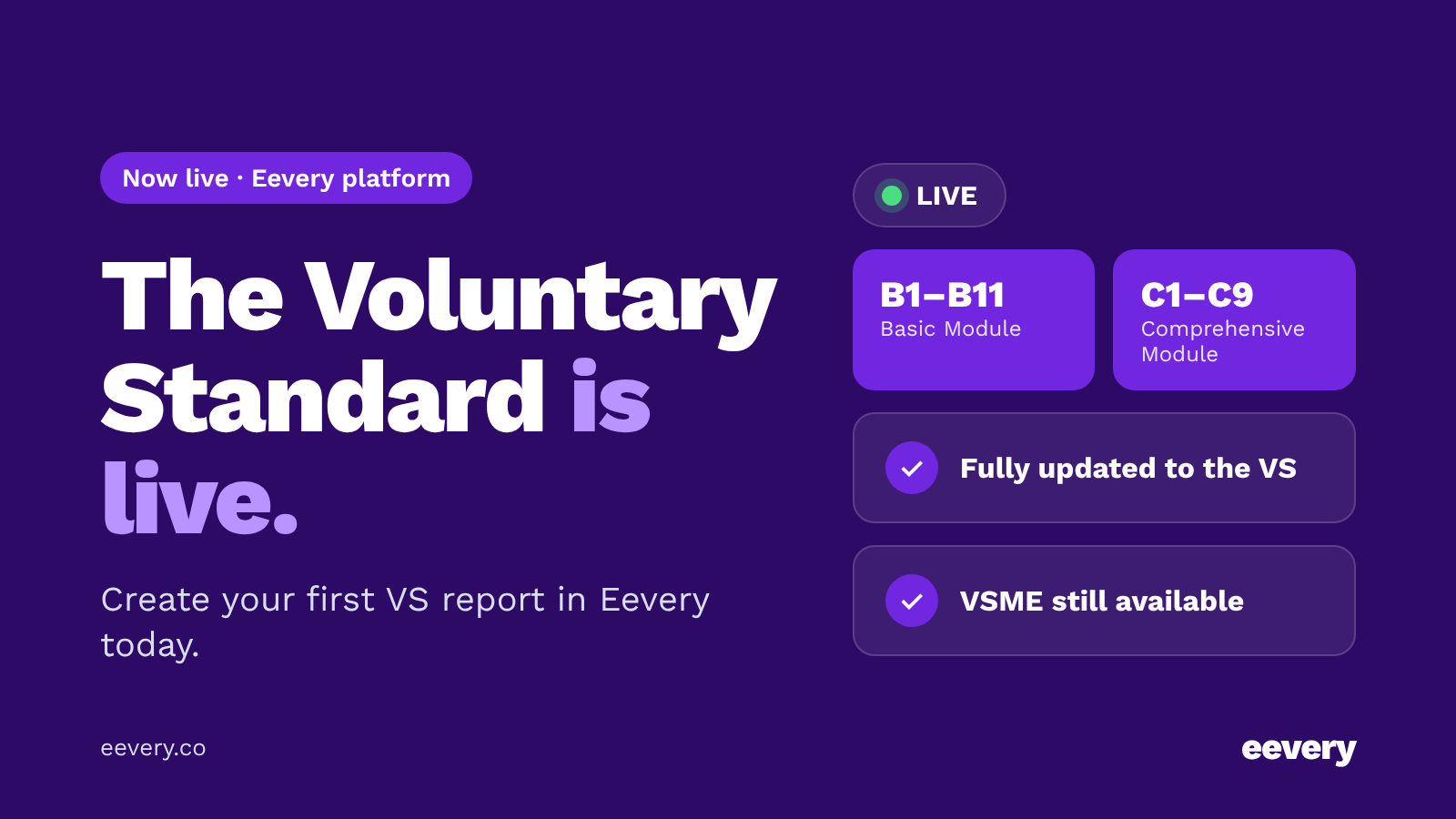
We are live in our platform: VSME becomes the Voluntary Standard (VS)!
That's a big milestone for us, and above all great news for you. Is your business getting more and more sustainability questions from customers or investors? You are not alone. Many SMEs fill in several ESG questionnaires every year, each one slightly different. The Voluntary Standard (VS) is set to change that. The VS is the successor to the VSME and has been official EU law since 24 September 2026. In this blog, you will read what the VS is, who it is for, what has changed compared to the VSME and how to get started in Eevery today.
What is the Voluntary Standard (VS)?
The Voluntary Standard is a European standard for voluntary sustainability reporting. It allows companies that are not required to report under the CSRD to show, in a simple and comparable way, how they perform on environmental, social and governance (ESG) topics.
The European Commission adopted the VS on 3 July 2026 in a delegated act, together with the revised ESRS for large companies (EFRAG, 3 July 2026). The VS was published as Commission Delegated Regulation (EU) 2026/1560 and entered into force on 24 September 2026.
In short: the VS is one fixed set of questions that SMEs can use to answer all sustainability requests from customers, banks and investors in one go.
What is the VSME and how does it relate to the VS?
VSME stands for Voluntary Sustainability Reporting Standard for non-listed SMEs. EFRAG developed this standard and the European Commission recommended it to SMEs in 2025. Many companies already work with the VSME. Read our earlier blog on voluntary sustainability reporting according to EFRAG.
The VS builds directly on the VSME. Its structure and logic stay largely the same. The biggest difference: the VSME was a recommendation, while the VS is an EU regulation. This makes the VS the official reference framework for voluntary reporting in Europe.
Who is the VS for?
The VS is intended for companies with an average of up to 1,000 employees: companies that are not required to report under the CSRD. That covers almost all SMEs.
The VS is voluntary, so you are not obliged to use it. Still, chances are you will come across it in practice, because:
- large customers need sustainability data from their suppliers for their own CSRD report;
- banks ask for ESG information for loan applications and their own reporting;
- tenders and investors look at sustainability more and more often.
With a VS report, you have one answer ready for all of these requests.
What has changed compared to the VSME?
The changes focus mainly on simplicity and clarity:
- From recommendation to regulation. The VS has an official legal status.
- A limit on what customers may ask. This is called the value chain cap (see below).
- No separate narrative module. The VS works with a Basic Module and a Comprehensive Module.
- A simpler applicability principle. You report on what applies to your business, without an extensive materiality assessment.
- Bank requests are built in. The information financial institutions need is included in the existing modules.
- Fewer requirements for small businesses. Some datapoints are voluntary for companies with 10 or fewer employees.
What does the value chain cap mean for you?
This may well be the most important change for SMEs. The value chain cap is a limit on what large companies may ask of you.
Companies that report under the CSRD may not ask suppliers with fewer than 1,000 employees for more information than the datapoints in Annex II of the VS for their sustainability reporting. This limit applies to financial years starting on or after 1 January 2027.
For you, this means:
- fewer separate questionnaires with ever-changing questions;
- clarity about which information you need;
- one VS report you can share with every customer who asks for it.
Please note: the cap applies to requests large companies make for their sustainability reporting. Requests based on other legislation are not covered.
Basic Module and Comprehensive Module: what do you fill in?
The VS consists of two modules. You always start with the Basic Module.
Basic Module (B1–B11) – the foundation for every business, including small companies:
- general information about your business;
- energy and greenhouse gas emissions (scope 1 and 2);
- pollution, biodiversity, water and waste;
- own workforce: headcount, health and safety, pay and training;
- convictions and fines for corruption and bribery.
Comprehensive Module (C1–C9) – for companies that want to provide more information, for example because a bank, investor or large customer asks for it:
- business model and sustainability strategy;
- scope 3 emissions, reduction targets and climate risks;
- additional information on workforce and human rights;
- revenue from certain sectors;
- gender diversity in the governance body.
New to emissions? Read our blog on a smart start with your CO₂ footprint as an SME or use our CO₂ calculator.
Why start now?
The VS is voluntary, but there are good reasons to start now:
- Your customers are preparing now. Large companies are aligning their supplier questionnaires with the VS. If you are ready, you won't have to rush.
- A stronger position with your bank. A VS report shows you are in control of your ESG risks.
- You see where you can improve. Once you map your energy use, waste and workforce data, you often spot ways to cut costs straight away.
- Do the work once, benefit many times. Fill in the report once and use it for all your customers, your bank and tenders.
How to create your first VS report with Eevery
Good news: you can get started right away. The VS is now live in Eevery's VSME reporting tool. Our team has updated every question, every guidance text and every report to the official VS text, so you can build your VS report step by step. Here's what you can expect:
- Only what applies to you. The tool shows which questions are required and which are voluntary for your company size.
- Guidance for every question. With practical tips and examples, so you know where to find your data.
- Report in English and Dutch. Ready to share with customers at home and abroad.
- VSME still available. If a customer or bank specifically asks for a VSME report, you can still create one in Eevery.
Curious how it works? Book a meeting or check our pricing. Are you an advisor or accountant? Have a look at our partners page.
Frequently asked questions about the VS
Is the VS mandatory for SMEs? No. The VS is a voluntary standard. However, customers and banks may ask you for information, and the VS is the way to answer those requests in one go.
What is the difference between the VSME and the VS? The VS is the successor to the VSME. The structure is largely the same, but the VS is official EU law, includes a limit on what customers may ask and is simpler on several points.
When does the VS apply? The VS entered into force on 24 September 2026. The limit on what large companies may ask (the value chain cap) applies to financial years starting on or after 1 January 2027.
I already have a VSME report. Do I have to start over? No. Because the VS builds on the VSME, you can reuse much of your data.
I have 10 or fewer employees. What do I need to fill in? You start with the Basic Module. Some datapoints are voluntary for you, and the Eevery tool clearly shows which questions you can skip.
Get started
Want to know where your business stands today? Book a free 60-minute sustainability score session. Together we look at five themes, you get an indicative score and a few quick wins, and you see how the VS works for your business.